
What Leelanau Deed Records Convey
A recorded instrument shows what its own text conveys: who gave, who received, and under which legal description. Leelanau County deed records sit alongside mortgages, releases, easements, land contracts, assignments, and notices inside the Register of Deeds system. The documents are related, but each does different work. The deed is the transfer instrument itself. A mortgage secures a debt. A release can end a recorded claim, while an easement preserves a right of use across the land.
| Instrument | Effect on the record | Typical research use |
|---|---|---|
| Warranty deed | Conveys the stated interest with covenants written in the instrument | Follow an ordinary sale transfer |
| Quitclaim deed | Conveys the grantor's interest without promising its extent | Trace family, trust, or title-cleanup changes |
| Personal representative deed | Conveys property through estate authority | Explain a probate-linked transfer |
| Tax or foreclosure instrument | Records a transfer arising from a statutory process | Identify a break from a private sale chain |
| Easement or release | Creates, changes, or ends a recorded burden or right | Read rights that survive beside ownership |
Treat index names and dates as leads, not conclusions. The document image supplies the proof: recording stamp, signatures, consideration language, and the full legal description that ties one instrument to one parcel.
Leelanau's 1963 Deed Index
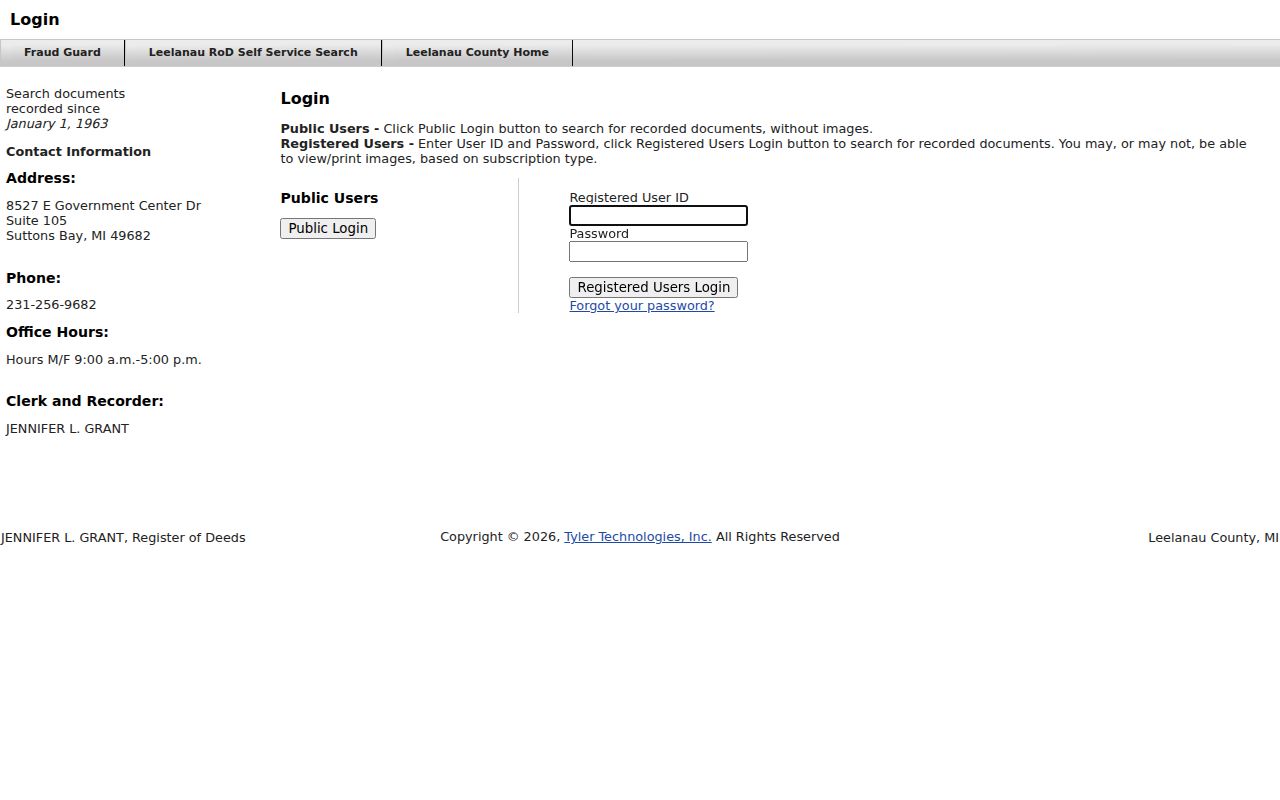
The Leelanau County recorded-document index covers instruments recorded from January 1, 1963 onward. Public Login allows an index search without document images. Registered image viewing and printing depend on the account subscription. JavaScript and cookies must be enabled. The official county recorder login shows the public entry point itself.
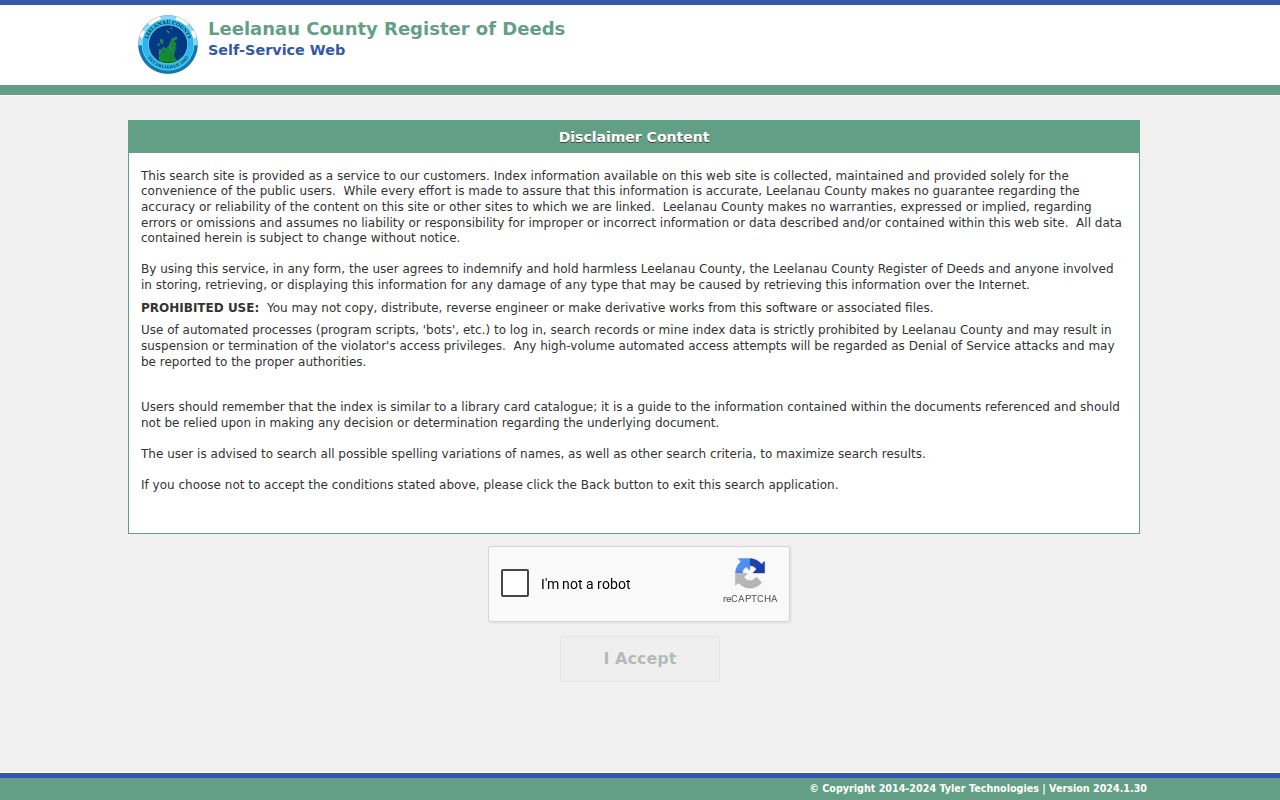
Before the index opens, the portal presents its terms. Tyler's disclaimer likens the index to a library card catalogue. That makes it a convenience rather than the underlying instrument. It carries no warranty. Search name variants, initials, entity spellings, and both sides of a transfer. Automated copying, redistribution, reverse engineering, bots, and high-volume requests are barred. A sparse result may reflect spelling quirks. It may also reflect index limits rather than the absence of a deed. The official index disclaimer displays the continue or start-over choice visitors face before access.
That warning is why every useful index hit must be checked against the recorded instrument itself.
| Verified entry | What is known | Important limit |
|---|---|---|
| Public Login | Opens recorded-document searching | Public access does not include images |
| Registered Login | Uses a user ID and password | Image rights depend on subscription |
| Search period | January 1, 1963 forward | Earlier deeds need an offline route |
| Name search | Grantor and grantee research is supported | Exact live result labels were not exposed |
Note: Hold onto the record date and reference number once you pull a deed result, because an assessor's name alone never replaces the full deed citation.
Build a Leelanau Deed Chain
A chain of title is simply an ordered sequence. The conveyances all tie to the same land. Start with a parcel number or legal description from the county assessor or GIS. Then use the current owner's name as a grantee lead in the deed index. Each verified deed supplies the prior grantor. That grantor becomes a grantee to search in an earlier transaction. Work backward deed by deed until the chain runs out.
- Find the most recent likely acquisition deed and open or request the recorded instrument.
- Copy the grantor, grantee, recording date, document type, and book/page or instrument number.
- Compare the legal description, lot and block, plat name, and referenced easements with the parcel being traced.
- Search the grantor as an earlier grantee, then repeat until the chain reaches the online cutoff or branches.
- When the trail branches through probate, a trust, foreclosure, merger, or replat, follow that linked record before continuing.
- Grantor
- The party giving or conveying the stated interest.
- Grantee
- The party receiving that interest.
- Chain of title
- The linked sequence of instruments for the same land.
- Liber and page
- The traditional deed-book citation used to retrieve a recorded item.
- Instrument number
- A unique filing reference used in newer record systems.
Match Leelanau Legal Descriptions
Street addresses help you find property, but deeds turn on the legal description. The Leelanau County assessor search offers several fields. They include Parcel No., Owner Name, Address Number, Street Name, and Jurisdiction. The parcel field uses the pattern 000-000-000-00 with dashes. It instructs users not to enter the county prefix 45. The GIS can then help you compare the candidate parcel with roads and adjacent polygons.
Carry the description from one deed to the next. Watch for numbered additions, replats, metes-and-bounds calls, split parcels, and parent or child parcel changes. An address may change over time. The recorded lot and block remain the stronger link. For map context, use the Leelanau County parcel map. But never treat a GIS boundary as a survey or a substitute for deed text.
Older Leelanau Deed Books
The online cutoff marks where the county's web index coverage begins. It does not mark where Leelanau County land records begin. For an earlier chain, contact the Register of Deeds at Suite 105 in the county government center, 8527 E Government Center Drive, Suttons Bay. You can also call 231-256-9682. Office hours are Monday through Friday, 9:00 a.m. to 5:00 p.m. Ask which older index, deed book, microfilm reel, or plat reference should be pulled for your parcel.
Archives add a second route. The Archives of Michigan guide identifies Leelanau tax assessment rolls for 1859 through 1900. It also lists Manitou County rolls for 1891 through 1893. Those rolls can place a name near land in a given year. They are not conveyances, though. The Library of Michigan county guide, local libraries, and the Leelanau Historical Society can supply maps, plat books, and newspaper clues. Those clues often lead back to the recorded deed book.
Online boundary. The verified web deed index begins in 1963. Earlier ownership work moves to deed books, plats, microfilm, and staff-assisted sources.
Northport's Burned Plat Clue
Leelanau County's official subdivision list tags “Northport Waukazoo” as burned or destroyed, and it gives no liber or page to fall back on. That parenthetical is a warning worth taking seriously. It does not mean every later deed or parcel in the area lacks a valid description. What it signals is simple. Record the exact wording and widen the source trail.
Search later conveyances for lot and block language. Inspect the deeds of adjacent lots too. Test references to Assessor's Plat No. 1, Assessor's Plat No. 2, additions, and later plats. Current GIS geometry can guide that search, but it cannot rebuild a destroyed historic plat. Old Northport and Leland newspapers may hold notices or name variants. Register of Deeds staff can often point to surviving references. Here the gap in the property record is itself part of the chain.
Deeds Versus Leelanau Encumbrances
Ownership history is not an encumbrance search. A deed transfers title, but it rarely tells the whole story. Mortgages, assignments, discharges, easements, restrictions, lis pendens, tax claims, and court orders can all bind land. They do not show up in the conveyance chain itself. So search each relevant party and document type around the dates the chain reveals. And match every release to the obligation it claims to end.
Michigan UCC records are indexed by debtor name rather than collateral or secured party. They usually cover personal-property security interests, not real estate title. MiCOURT results are informational and not the official court record. Reach for those sources only when a deed points toward an entity. That includes a lawsuit, probate, or foreclosure.
Request a Leelanau Deed Copy
If the public index shows no image, write down the names, date, instrument type, and citation before you call the Leelanau County Register of Deeds. The office answers at 231-256-9682, and the state listing lists a fax at 231-256-8149. You can view records in person. The office publishes no current fee schedule or official mail and email order form, so ask about cost, format, identification, and turnaround before you send payment or make the trip.
A plain image works for early research. A certified copy carries the office's authentication, which matters when formal proof is required. Order the right one. Keep the recording stamp and every referenced exhibit attached, because a missing attachment can change how the legal description reads.
Recorded is not guaranteed. Leelanau County deed records show indexed filings, not a title opinion, and unrecorded interests or indexing errors may exist.