
Find Out Who Owns Leelanau County Property
Ownership searching begins with land identity. A street address is easy to recognize, but the parcel number and legal description keep the search tied to the right tract. Use the official sources in order. Keep the date of each result along the way.
- Search the physical address in the county assessor portal and copy the APN, owner string, and jurisdiction.
- Use ArcGIS to make sure the APN identifies the intended parcel.
- Search the owner or grantee in the recorder index and inspect the latest relevant deed.
- If an entity is named, use Michigan's current business registry for entity context without treating an agent as the landowner.
The assessor entry names the person or entity on the dated roll. The deed shows the recorded transfer, so agreement between the two is stronger evidence than either record alone.
Start With the Leelanau Assessor Owner String
The Leelanau County parcel search accepts Parcel No., Owner Name, Address Number, Street Name, and Jurisdiction. Search the known address first. Save the owner name exactly as displayed. Initials, punctuation, and entity suffixes can matter later.
The public roll is dated administrative data. The county publishes no verified refresh interval, so treat its name as current only on the day you searched. Check the recorder for a more recent instrument.
The official search screen displays each of these fields. Compare the live assessor form to the reference image first.
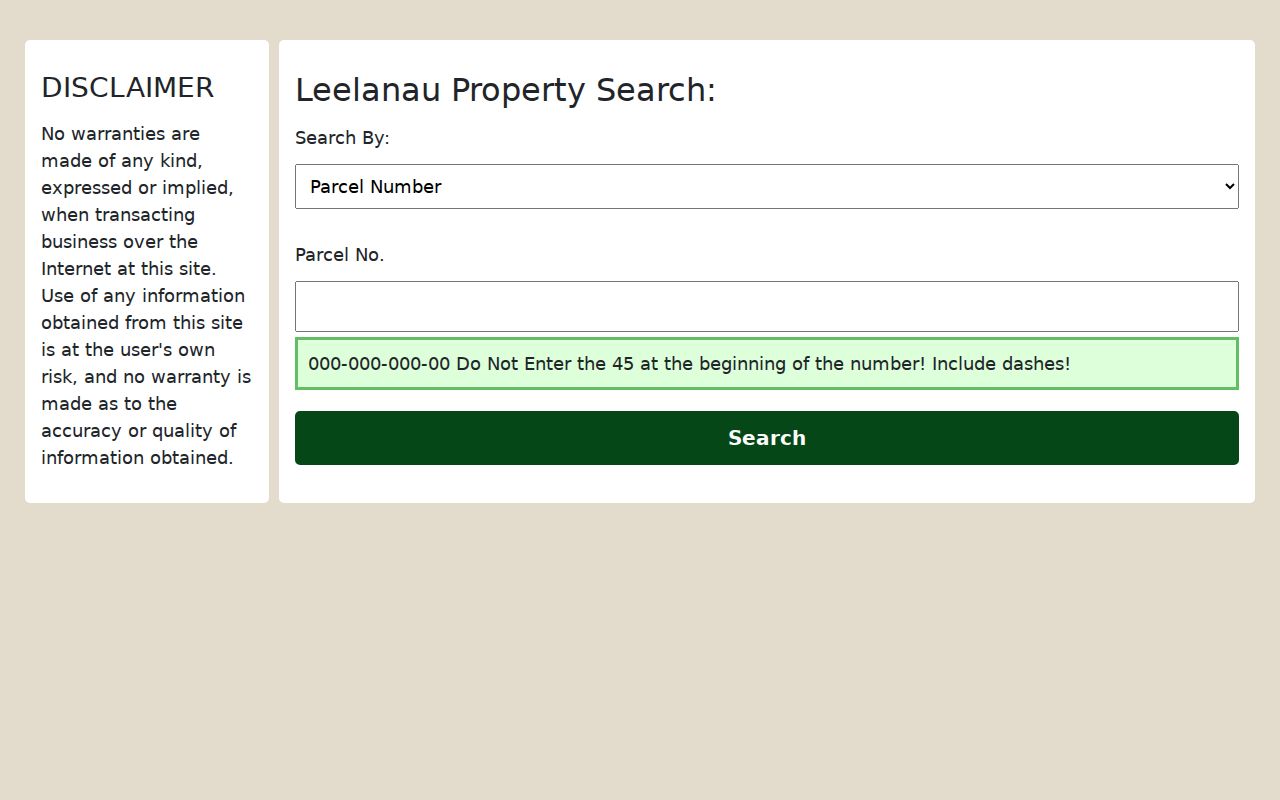
Separate parcel, owner, address, street, and jurisdiction fields support that first ownership step.
Where Leelanau County Property Ownership Appears
Different official sources answer different parts of the ownership question. Dates and authority matter more than how many databases repeat the same name.
| Source | Owner Info It Gives | Access |
|---|---|---|
| Assessor roll | Dated owner string and parcel identity | County parcel search |
| Recorder deed index | Grantee and the recorded transfer trail | Public index from 1963; images may require access |
| Michigan business registry | Entity filing context | Current state registry |
| GIS parcel viewer | Mapped parcel identity and location | County ArcGIS viewer |
An occupant is not always the property owner. Public ownership records cannot tell you who lives at an address. Mailing, situs, grantee, and registered-agent addresses each serve a different record function.
Confirm the Leelanau Owner on the Latest Deed
The Register of Deeds public index reaches back to documents recorded since January 1, 1963. Search the assessor name as a grantee. Try reasonable spelling variants. Then compare the deed's legal description with the parcel. A new deed can outrank the tax roll. Public users may search the index without document images, while registered image access requires a subscription. The index is only a finding aid, so when the transfer matters, obtain and read the deed or call the Register of Deeds at 231-256-9682.
Read Trust, Estate, and LLC Owner Names as Written
A Leelanau County property owner may appear as a trust. It may also appear as an estate, a corporation, or a limited liability company. Search the full indexed string first. Shorten it only if nothing matches. For entities, Michigan moved its current entity search to MiBusiness Registry on June 23, 2025. Older legacy-search instructions may no longer apply. An entity record can link a deed grantee to a state filing. It does not automatically reveal a beneficial owner or prove fee title. A registered agent is a filing contact. That person or company may not own the land. Probate files may explain an estate transfer, though protected court material stays restricted.
Ownership words
Owner of record means the party on a dated roll. A grantee receives an interest in a deed. Title is the legal ownership interest, and a situs address locates the land, sometimes apart from the mailing address.
Use Leelanau GIS Only to Verify the Parcel
The Leelanau ArcGIS viewer displays tax parcels, labels, roads, municipal lines, sections, government lots, and aerial imagery. Use it to confirm the APN. That check proves the assessor result matches the land you intended. The map does not prove ownership. It does not settle boundaries either. A parcel polygon is for navigation. The assessor supplies the dated owner string, and the recorder supplies the instrument, so never infer an owner from an adjacent map label.
Fraud Guard Watches a Leelanau Name, Not a Parcel
Leelanau County's free Fraud Guard emails you when a document is recorded under an enrolled name. It works well as a follow-up. After you learn who owns a property, it can flag a later name-based filing. An alert is not proof of fraud. It is not a title policy or a parcel-specific monitor. Read any unfamiliar instrument and contact the Register of Deeds, since name variants affect alerts just as they affect index searches.
Limits on “Who Owns This Property” in Leelanau County
The official route identifies the name on a dated roll. It also shows the parties on recorded instruments. It does not prove occupancy. It cannot reveal every private interest, resolve a boundary, or replace professional title work. Sometimes a trust or entity name is the full public answer.
Use owner records lawfully. Public data supports property diligence and civic review; it does not permit trespass, threats, repeated unwanted contact, stalking, or harassment.
Michigan's Address Confidentiality Program provides a substitute address and mail forwarding for eligible survivors. Public land records still exist. Agency-specific redactions and protected addresses remain in force regardless. For a deeper look at the present owner, use the Leelanau County current owner guide.
Ask the Leelanau Custodian When Dates Conflict
Dates can clash. The assessor's owner string may disagree with the most recent deed. Resist picking one on instinct. Match the parcel number and legal description across both records first. Then read the deed itself and write down each source date. The Register of Deeds office sits at 8527 E Government Center Drive, Suite 105, Suttons Bay. It is open weekdays from 9:00 a.m. to 5:00 p.m.
A split, trust transfer, probate event, foreclosure, or spelling change can explain almost any conflict. So can a simple update lag. Sometimes the honest answer is that the public sources disagree. In that case, a title professional should interpret the instruments.